What Detergent Works Best in a Countertop Dishwasher?
Use automatic dishwasher detergent in a countertop dishwasher, never regular liquid dish soap. Pods, powder and gel are the usual forms, so follow your maker's manual for the type and amount.
On this page (13 sections)
- Why regular dish soap does not belong in the machine
- Pods, powder or gel: which form should you choose?
- Can you use the same detergent you used in a full-size dishwasher?
- Where does the detergent go?
- What are the common detergent mistakes?
- How should you store pods and powder?
- When does rinse aid help?
- Hard water and spots: what detergent can and cannot do
- How much countertop dishwasher detergent should you use?
- What should you do when dishes come out cloudy or spotted?
- What should you check on the label and in the manual?
- Does skipping the pre-rinse really save water?
- Which countertop dishwasher detergent to pick
The right countertop dishwasher detergent is an automatic dishwasher product, not regular dish soap. Pods, powder and gel are the usual forms, and your unit's manual names the type and amount it expects.
This guide compares those forms, explains where rinse aid fits and shows how much to use. For the units themselves, see our countertop and portable dishwashers guide.
Why regular dish soap does not belong in the machine
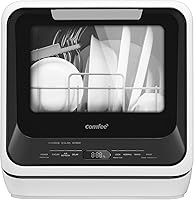
Regular liquid dish soap is made for washing by hand, so keep it out of a countertop dishwasher. It makes a lot of suds, and COMFEE' says it will cause dishwasher problems.
Check your manual before you buy, since it names the detergent types your unit takes. If dish soap went in by mistake, read the manual for what to do before you run another load.
A slow drain afterward can come from the sink or the hose, so see portable dishwasher not draining for the checks to make.
Pods, powder or gel: which form should you choose?
Pods are the simplest to use because they need no measuring, while powder and gel let you match the amount to a light or heavy load. Check that your manual allows the form you pick.
Finish says its pods dissolve easily and need no pre-measuring. Each form can work in a countertop unit when the manual allows it, so habit and the amount of measuring you want decide most of the choice.
A pod carries a set dose. A countertop unit uses much less water per cycle (Hermitlux says its unit uses 5 liters), so check that your manual allows pods at all.
If you are still choosing a unit, our best countertop dishwashers for apartments guide compares models by size and hookup.
Finish Quantum pods with three chambers
Finish says Quantum pods use three chambers, with powder for stuck-on food, gel for grease and a Powerball for shine. The brand also says they leave a virtually spot-free shine on everything from wine glasses to stainless steel pans.
Cascade Platinum pods that combine powder and liquid
Cascade says its Platinum pods combine powder and liquid soaps in one pack, with scrubbing action and grease cutting power. Cascade also says the pods have built-in rinse aid action plus water softeners to help prevent hard water deposits on glasses.
Finish Powerball pods with a wrapper-free film
Finish Powerball pods come in a wrapper-free, water-soluble film with three fast-dissolving layers. Finish says the layers break down tough messes and cut grease.
How the three pod packs compare
All three are pods, so the main differences are pack size, build and what each brand claims. The table sets them side by side.
| Feature | Finish Quantum | Cascade Platinum | Finish Powerball |
|---|---|---|---|
| Pack size | 84 count | 59 count | 84 count |
| Build | 3 chambers: powder, gel, Powerball | Powder and liquid in one pack | 3 fast-dissolving layers, wrapper-free film |
| Brand claim | Virtually spot-free shine | Built-in rinse aid action, water softeners | Breaks down tough messes, cuts grease |
Pack counts and how often you will reload
Divide the pack count by the loads you run each week to see how long a pack lasts.
A larger count does not make a better pod. Compare the form, the chambers and the way each pack fits your routine instead.
Keep one sealed spare pack somewhere dry, so a busy week does not leave you without detergent.
Can you use the same detergent you used in a full-size dishwasher?
Often yes, if your manual allows that form, but don't carry the old dose over. A small unit sets its own amounts, so follow its manual instead of your habit.
COMFEE' shows why amounts differ: on its 1.32-gallon model, the Rapid program needs half the standard amount and the Fruit program needs none. A pod or scoop sized for a bigger machine may be more than a small load needs.
If the manual doesn't name a detergent form, ask the maker before you buy a large pack.
Where does the detergent go?
Put detergent only where your manual says, which is usually a dispenser that opens during the cycle. Check this on your own model, because small units set it up their own way.
Add it just before you start, and close the dispenser fully. If you skip detergent for a program, as COMFEE' says to do for Fruit, leave the dispenser empty.
What are the common detergent mistakes?
Most detergent problems come from the wrong product, the wrong amount or a pack left open. Each one is easy to avoid once you know to look for it.
- Using regular dish soap, which COMFEE' says will cause dishwasher problems.
- Measuring powder or gel by eye instead of using the amount the manual gives.
- Leaving the pack open, so moisture gets in.
- Filling a rinse aid dispenser with detergent, or skipping rinse aid on a unit that has one.
- Buying a new type without checking the manual, since each unit names its own types.
Check these first before you blame the unit or change brands.
How should you store pods and powder?
Keep detergent in its original packaging, closed tight and away from water and heat. Finish says its resealable packaging helps keep moisture out, so reseal the pack after every load.
Keep pods out of reach of young children, even if the pack sits under the sink. The Consumer Product Safety Commission has general safety information for household products.
If the unit travels in an RV or camper, keep the pack in a sealed container so it stays dry and doesn't spill on the road.
When does rinse aid help?
Rinse aid helps dishes dry with fewer water spots, and Finish Jet-Dry is one option if your unit has a rinse aid dispenser. It is not a detergent, so it does not replace one.
Finish says rinse aid enhances drying and reduces water spots, and that Jet-Dry helps prevent residue and spots. The brand says to refill the dispenser about once a month.
Check the manual before you add it, since not every countertop unit takes a rinse aid.
Hard water and spots: what detergent can and cannot do
Hard water leaves white marks and film on glasses and dishes. Cascade says its pods include water softeners to help prevent hard water deposits on glasses, and Finish says Jet-Dry helps prevent residue and spots.
Those are claims about prevention, which is different from removing a film that is already there.
Some units handle hard water themselves. HAVA says its TDJR09 tank model has an integrated water softener, with a setting you choose based on your water hardness.
If you already see a film after many loads, check the manual's cleaning notes and your water hardness before you add more detergent. Your local water utility can tell you how hard your water is.
For tank models with built-in features, see best countertop dishwashers with a water tank.
How much countertop dishwasher detergent should you use?
Use the amount your manual gives for your load, and change it only for the program you pick. COMFEE' says its Rapid program needs half the standard amount, and its Fruit program needs no detergent at all.
Countertop dishwasher detergent amount by program
Program rules change from model to model, so check the manual before you measure. The COMFEE' figures come from its 1.32-gallon tank model and show how one program can change the amount.
Pods already hold a set amount, so the program question matters most with powder and gel. Measure powder or gel with the cup or dispenser your manual describes, and level it off rather than heaping it.
Our how to use a countertop dishwasher guide covers loading and program choice.
What should you do when dishes come out cloudy or spotted?
Cloudy glasses and spots often point to hard water, too little detergent or a missing rinse aid. Work through those three before you change the unit.
Check the rinse aid level first, if your unit has a dispenser. Then confirm the detergent amount for your program in the manual.
If the spots remain, look at how the load sits in the racks. Items that block the spray or touch each other can keep water from reaching every surface.
If the film keeps returning, the maker or a repair pro can check the spray arms and the filter.
Change one thing at a time
If the spots stay, change one thing per load: the amount, then the rinse aid, then the program. That shows which change helped, and it keeps you from buying products you don't need.
Write down what you changed, so you can go back to the setting that worked.
What should you check on the label and in the manual?
Look for four answers before you buy detergent, because they shape most of what you need. Compare the packs by form and count, not by name.
- The detergent types the manual allows, such as pods, powder, gel or tablets.
- The amount for your usual program, and any program that needs less or none.
- Whether the unit has a rinse aid dispenser, and where it sits.
- How many loads a pack covers, so you can plan your restocking.
Does skipping the pre-rinse really save water?
Finish and Cascade both say skipping the pre-rinse can save up to 20 gallons of water per load. Those are the brands' own figures, and the real saving depends on how much you would have rinsed.
Scrape large food pieces into the trash, and check your manual for its advice before you skip the rinse. For how this compares with washing by hand, see dishwasher vs hand washing water use.
Which countertop dishwasher detergent to pick
Pick pods if your manual allows them and you want no measuring and a simple load. Pick powder or gel if you want to control the amount, or if your manual asks for it.
Pick a rinse aid only if your unit has a dispenser and your dishes or glasses come out spotted.
Whichever form you choose, use the amount in your manual and keep the pack sealed and out of reach. For a unit that fits a tank setup, see best countertop dishwashers with a water tank.
Frequently asked questions
Can I use regular dish soap in a countertop dishwasher?
No, because COMFEE' says regular liquid dish soap will cause problems in its dishwashers, so use standard dishwasher powder or detergent instead. Check your manual too, since it names the detergent types and amounts that your own unit takes, and follow it over any general advice.
Are dishwasher pods better than powder or gel?
Pods are the simplest to use because they need no measuring, while powder and gel let you match the amount to a light or heavy load. Check that your manual allows pods before you use one, since a small unit may call for a smaller dose.
Do I need rinse aid in a countertop dishwasher?
Not always, since rinse aid is an extra that helps dishes dry with fewer water spots. Add it only if your unit has a rinse aid dispenser, and check the manual for where it goes, because Finish says its Jet-Dry helps prevent residue and spots.
How much detergent should I use?
Use the amount your manual gives for your load and program, and change it only as the manual says. COMFEE' says the Rapid program on its 1.32-gallon model needs half the standard amount and its Fruit program needs none, so program rules vary by model.