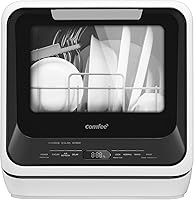
How to Use a Countertop Dishwasher: Loading and Cycles
To use a countertop dishwasher, load within the plate limit, fill the tank or connect the faucet, add dishwasher detergent and pick a cycle. The maker's manual sets the exact buttons and amounts.
On this page (10 sections)
- How do you use a countertop dishwasher the first time?
- How do you load a countertop dishwasher?
- How do you fill the tank on a countertop dishwasher?
- Which cycle should you pick?
- How much detergent do you use?
- Where does the rinse aid go?
- How do you keep the spray arms and filter clean?
- How do you unload and reset after a run?
- What should you check when a cycle comes out wrong?
- Use a countertop dishwasher within its limits
Here is how to use a countertop dishwasher: load the racks within the plate limit, fill the tank or connect the faucet, add dishwasher detergent and pick a cycle. Most steps are the same from one model to the next.
The buttons, cycle names and tank steps do change, so the maker's manual wins wherever it differs from this guide.
This guide uses the COMFEE' 1.32-gallon and Hermitlux 5-liter tank models as examples, with notes on rinse aid and care. For the wider picture, see our countertop and portable dishwashers guide.
How do you use a countertop dishwasher the first time?
Read the manual, set the unit up, load it, fill the tank, add detergent and start a cycle. The steps below follow that order, so you can check each one against your own unit.
- Read the maker's manual for the buttons, cycles and tank steps.
- Set the unit on a counter or table near an outlet, with room for the drain hose.
- Leave enough height above it. Hermitlux says at least 20.08 inches should separate the countertop from the wall cabinets, and COMFEE' says more than 19.6 inches.
- Load the racks within the plate limit, as the next section explains.
- Fill the tank, or connect the faucet if your model allows it.
- Add dishwasher detergent in the amount the manual gives.
- Choose a cycle and start it. When it ends, let the used water drain as the manual says, then unload.
Watch the first run closely, because it shows how the buttons, the tank and the drain behave. Keep the manual near the unit for the first few runs.
After that, the steps become routine.
Pick a steady spot for the unit
Use a level counter or table that can carry the weight. The COMFEE' unit weighs 36.6 pounds and the Hermitlux 30.9 pounds, before any water goes in the tank.
Keep the unit back from the counter edge, and leave the cord and hoses free of sharp bends. Hermitlux says its unit runs on 120 volts, so it needs a nearby wall outlet.
How do you load a countertop dishwasher?
Load plates within the size limit, keep items from blocking the spray arms, and leave space between pieces so water can reach them. The two models here differ on plate size and spray pattern, so check the table before you load.
| Feature | COMFEE' 1.32-gallon | Hermitlux 5-liter |
|---|---|---|
| Capacity | 30 or more items | 5 full place settings |
| Plate limit | 9.5 inches | 10.25 inches at an angle |
| Spray | 360 degree dual spray | 14 water jets, top and bottom |
| Space above the unit | More than 19.6 inches to the wall cupboard | At least 20.08 inches to the wall cabinets |
Those limits decide what fits, so measure your largest plate before you load. A plate over the limit may not fit the rack at all, so set it aside for hand washing.
Hermitlux says dishes up to 10.25 inches fit at an angle, so lean a large plate instead of laying it flat.
Keep the spray arms clear
Hermitlux says its spray arms have 14 water jets that spray from the top and bottom. Lay bowls and cups facing down, and follow the rack diagram in your manual for tall pieces.
Items that sit in the spray path stop water from reaching the other dishes. Rearrange the rack if a run leaves dry or spotted pieces in one spot.
What not to load
Leave out anything your manual says isn't dishwasher safe, and anything larger than the rack allows. Wooden handles, fine hand-painted china and thin plastic are common pieces to check first.
What to check before you close the door
A quick look before you start catches most loading mistakes. Four checks cover it.
- Scrape large food scraps into the trash.
- Keep bowls and cups from nesting, so water reaches the inside.
- Make sure nothing sticks out and blocks a spray arm.
- Close the door fully before you press start.
How do you fill the tank on a countertop dishwasher?
Fill the built-in tank by hand before you start the cycle, up to the level your manual shows.
COMFEE' includes a water pitcher and a fill guide on its tank. Hermitlux says to use the funnel to control the flow and prevent overflow.
Fill it before you press start, not partway through a run. Tank models still need an outlet, and the used water still needs a place to go, so plan where the drain hose ends before the first run.
Both brands also describe a faucet option. COMFEE' says its unit hooks to the kitchen faucet with the included hose and adapter, and Hermitlux has a faucet mode too.
Check your faucet first, and follow the maker's manual for the connection.
How to use the tank on a countertop dishwasher
Both tanks hold about 5 liters, which is roughly 1.32 gallons. Hermitlux says its unit uses 5 liters per cycle, so one full tank covers one run.
Refill the tank before the next run. For a side-by-side look at tank and faucet models, see water tank vs faucet hookup.
Which cycle should you pick?
Pick a normal cycle for everyday dishes, a rapid or quick cycle for light soil and a glass cycle for glassware, if your model has one. Cycle names differ by maker, so match them to your manual.
COMFEE' offers Normal, Rapid, Fruit and Glass programs, plus an Air Refresh drying mode. Hermitlux names seven programs: Standard, Quick, Strong, ECO, Fruit, Self-clean and Glass.
Rapid, normal or strong?
A rapid or quick cycle suits dishes that are only lightly soiled, since a shorter run gives food less time to loosen. A normal or standard cycle covers everyday loads with ordinary soil.
Heavier soil calls for the strong or heavy program your model has. Pick the shortest program that still matches how dirty the dishes are.
If you're unsure, start with the normal cycle and change it only if the dishes come out dirty.
Delay start, child lock and drying
Hermitlux says its delay start can run up to 18 hours, and it adds a child lock for the controls. Hermitlux also says the delay lets you use off-peak power rates.
For drying, Hermitlux says it offers 60 minutes of hot air drying that works with any cycle except Fruit. COMFEE' says its Air Refresh mode circulates air to keep the dishes and the machine dry, and you can turn it off.
How much detergent do you use?
Use dishwasher detergent, never regular dish soap, and follow the amount your manual gives. COMFEE' says regular liquid dish soap will cause dishwasher problems.
COMFEE' also says its Rapid program needs half the standard amount of detergent, and its Fruit program needs none.
Amounts and forms vary by maker, so the manual is the final word. For pods, powder and gel, see our countertop dishwasher detergent guide.
Where does the rinse aid go?
Put rinse aid in the dispenser, but only if your manual shows one on your unit. Finish says rinse aid enhances drying and reduces water spots, and that most dishwashers have a rinse aid compartment.
Finish says to refill Jet-Dry about once a month. A small unit may not have a compartment at all, so check the manual before you buy a bottle.
How do you keep the spray arms and filter clean?
Clean the filter as your manual says, and run a dishwasher cleaner about every three months if the manual allows it. Finish says its liquid cleaner targets grease, hard water buildup and limescale in the spray arms, filter and pipes.
Finish directs you to stand the bottle upside down in the bottom rack and run a hot cycle. Finish says it works with standard, older and small dishwashers, but check that your manual and your rack allow it.
Hermitlux describes its filter as self-cleaning, and you should still follow the manual's cleaning steps.
When to unplug and check the drain
Unplug the unit before you check the drain hose or the filter. Our portable dishwasher not draining guide walks through the simple checks.
If the problem keeps happening, contact the maker or a repair pro. The Consumer Product Safety Commission publishes appliance safety information and recall notices.
How do you unload and reset after a run?
Let the cycle finish and the water drain, then open the door and unload. Take out the lower rack first if your unit has two, so drips from the upper rack don't land on dry dishes.
Wipe the door edge and the filter area as your manual allows. Follow the manual on whether to leave the door open and whether to leave water in the tank between runs.
What should you check when a cycle comes out wrong?
Check the load, the detergent and the filter first, because those are the quickest things to fix. Start with the load, since a crowded rack or an item in the spray path can block water.
Next, confirm you used dishwasher detergent rather than dish soap, and that the amount matched your program.
Then clean the filter as the manual describes, because a clogged filter can leave residue behind. If the cycle still doesn't finish or drain, contact the maker.
Use a countertop dishwasher within its limits
To use a countertop dishwasher well, load within the plate limit, fill the tank or connect the faucet, use dishwasher detergent only and clean the filter on the schedule your manual gives. Those four habits cover the basics.
Pick a tank model if you want no faucet hookup and don't mind filling it before each cycle. Pick a faucet-fed model if a sink sits close by and you'd rather skip the filling.
Keep the manual with the unit, and check it again before any repair call.
If you're still weighing the purchase, read are countertop dishwashers worth it. For a shortlist of tank models, see best countertop dishwashers with a water tank.
Frequently asked questions
How do you use a countertop dishwasher the first time?
Read the maker's manual, then load the racks, add dishwasher detergent, choose a cycle and start it. For a tank model, fill the tank first, and follow the manual's first-run steps, since each maker names its buttons and programs differently.
What detergent goes in a countertop dishwasher?
Use dishwasher detergent and never regular dish soap, because COMFEE' says regular liquid dish soap will cause dishwasher problems. Follow the amount your manual gives for your load and program, and note that COMFEE' says its Rapid program needs half the standard quantity.
Do you have to fill a countertop dishwasher tank by hand?
Yes, tank models need you to fill the tank by hand, and the COMFEE' and Hermitlux units each hold about 5 liters. Faucet-fed models connect to a faucet instead, so check your faucet first and follow the maker's manual for the connection.
Why is there water in my countertop dishwasher?
Hermitlux and COMFEE' both say a little leftover water in a brand-new unit is normal. If water stays in after a full cycle, unplug the unit, check the drain hose for kinks and contact the maker if the problem keeps happening.