Countertop and Portable Dishwashers: The Complete Guide
Countertop and portable dishwashers come in three main types: water tank, faucet-fed and rolling portable. Pick the type your sink, outlet and counter or floor space can support before you compare brands.
On this page (22 sections)
- Three ways a countertop dishwasher gets its water
- Chooser table: tank, faucet-fed or rolling portable
- Sizes and clearance for countertop dishwashers
- Place settings and plate size
- Water, power and drain basics
- Water, noise and energy claims to compare
- Filters, drying and everyday upkeep
- Who a countertop dishwasher suits
- How to measure before you order
- How a tank model works, step by step
- Day one with a new countertop dishwasher
- What fits in a countertop dishwasher
- Who should skip a countertop dishwasher
- Cord and hose lengths decide where it sits
- Floor space for a rolling portable
- Countertop models with a water tank
- Guides to rolling portable dishwashers
- Hookups, adapters and hoses
- RV and tiny-space picks
- Use, care and detergent
- Comparisons and buying questions
- Pick a countertop dishwasher by your hookup
A countertop dishwasher is a small unit that sits on your counter or rolls on a base, so you can wash a load without a full-size install.
Countertop and portable dishwashers come in three main types: water tank, faucet-fed and rolling portable. Each type needs a different setup, so the right one depends on your sink, your outlet and your space.
This guide sorts the models we looked at into those three types. It covers size and clearance, place settings, water and drainage, and the questions renters and RV owners ask most.
Every section links to a deeper guide, so you can go straight to the decision in front of you. The figures are the sizes, weights and claims the makers give for each model.
Three ways a countertop dishwasher gets its water
Five of the eight models we looked at have their own water tank, and three depend on a faucet connection. Your water source sets how much setup you do and where the unit can sit.
Water tank countertop dishwashers
A tank model holds about 5 liters, or 1.32 gallons, and you fill it by hand. All five tank models in this guide also support a faucet connection through an inlet hose, so you can switch later if you want to.
Tank models suit renters, dorm residents and RV owners who want nothing installed. The trade-off is that you fill the tank yourself every time, and you still need an outlet and a drain.
Faucet-fed countertop dishwashers
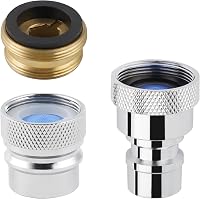
A faucet-fed model connects to your faucet with a hose and an adapter, so it has no tank to fill. BLACK+DECKER includes a faucet adapter with the BCD6W, while COMFEE' says its six-place model needs a suitable adapter, so check what comes in the box.
Check your faucet first. The aerator type and thread size decide whether an adapter fits, and the faucet fit guide walks through that check.
Rolling portable dishwashers
A rolling portable sits on wheels, so you can move it to the sink and back out of the way. The BLACK+DECKER rolling model in this guide holds eight place settings and connects to a faucet with a quick-connect assembly.
The name says 18-inch, but the unit is 23.6 inches wide and 17.6 inches deep. Use the real numbers, not the name, when you plan floor space.
The unit weighs 116 pounds, so plan a clear route from the sink to the spot where it will park.
Chooser table: tank, faucet-fed or rolling portable
Pick the type by its water source first, since that decides where the unit can sit and what you need to buy. The table puts the three types side by side with the sizes and capacities the makers give.
| Type | Water source | Size, W x D x H (in) | Capacity | Best fit |
|---|---|---|---|---|
| Water tank countertop | Fill the 5-liter tank by hand, or use the inlet hose at a faucet | 16.5 to 16.9 x 16.7 to 17.1 x 17.2 to 18.2 | 4 to 5 place settings, or 30+ items | Renters, dorms, RVs and counters with no faucet nearby |
| Faucet-fed countertop | Hose and adapter to a faucet, drain to a nearby sink | 21.7 x 19.7 to 21.5 x 17.2 | 6 place settings | Counters with room and a faucet that takes an adapter |
| Rolling portable | Quick connect to a faucet | 23.6 x 17.6 x 35.6 | 8 place settings | Bigger households with floor space and a faucet nearby |
Read the water source column first, then check the size column against your counter or floor. A model that fits your space but not your water source can still be the wrong pick.
A tank model fits best when a faucet is hard to reach or when you may move the unit often. In return, you do more filling work, and the 5-liter tank sets how much water each fill holds.
A faucet-fed model fits a counter with room and a faucet that will take an adapter. You skip the filling step, but you must check the faucet and keep the drain route clear.
A rolling portable fits a household that wants the most place settings and can spare the floor space. It needs a faucet within reach of its hose, and its 116-pound weight means you will roll it rather than carry it.
Sizes and clearance for countertop dishwashers
Tank models in this guide measure about 16.5 to 17 inches wide, which is narrower than the faucet-fed models at 21.7 inches. Measure the counter, the cabinet above and the path to the sink before you choose.
Width, depth and height by type
Tank models measure 16.5 to 16.9 inches wide, 16.7 to 17.1 inches deep and 17.2 to 18.2 inches tall. The two faucet-fed countertop models are 21.7 inches wide, and the rolling model stands 35.6 inches tall.
The small dishwasher dimensions guide puts each model's measurements in one table, with weight and place settings.
Leave room above the unit
Three tank-model makers give clearance advice, and their numbers run from about 19 to 20 inches between the countertop and the cabinet above. COMFEE' says more than 19.6 inches, EUHOMY says more than 19 inches, and Hermitlux says at least 20.08 inches.
Those numbers are the makers' advice, not a rule for every kitchen. A tank model that is 17 to 18 inches tall leaves only a couple of inches in that gap, so measure your own cabinets before you order.
Place settings and plate size
Capacity runs from 4 to 8 place settings in this group, and plate limits run from 9.5 to 12 inches. Choose by how many people you cook for and by the size of your biggest plate.
Four place settings cover a day of meals for one or two people, and six or eight give a bigger household more room per load. COMFEE' says its six-place model suits two or three people.
Plate limits can matter more than the place-setting count. The COMFEE' tank model takes plates up to 9.5 inches, most of the other models take 10 to 11 inches, and the NOVETE tank model fits 12-inch dishes loaded at an angle.
Water, power and drain basics
Every model here needs a power outlet, and each one needs a place for the waste water to drain. Filling a tank by hand does not remove either need.
Tank models still need power and a drain
A tank model skips the water line, but it still plugs into an outlet and sends its waste water somewhere. The HAVA, EUHOMY and NOVETE tank models all include a drain hose, and the maker's manual explains where the water should go.
Faucet-fed models depend on your faucet
Check your faucet first, because the adapter has to match its threads and some faucet heads change the fit. BLACK+DECKER says the BCD6W works anywhere with a faucet and an outlet nearby, and its waste water drains to a nearby sink.
Hose threads vary too. EUHOMY says its tank model fits G3/4-inch faucet connections and asks buyers to buy a faucet adapter separately, and COMFEE' gives a water pressure range of 0.04 to 1.0 MPa for its tank model.
A permanent install is a different job. Follow the maker's manual, and ask a licensed plumber or electrician before you change any plumbing or electrical part.
Can You Install a Portable Dishwasher Permanently? explains where those limits sit.
Water, noise and energy claims to compare
Water, noise and energy figures come from each maker, so read them as the maker's claims. Use them to compare models, not as guarantees.
- COMFEE' gives 62 dB for its tank model and 52 dB for its six-place model.
- EUHOMY says its tank model runs at 40 dB.
- HAVA and Hermitlux both say their tank models use 5 liters of water per cycle.
- COMFEE' says its six-place model uses as little as 2.77 gallons per cycle.
- BLACK+DECKER says its BCD6W is Energy Star certified.
The Energy Star program is run by the Environmental Protection Agency and the Department of Energy. You can check certified models at energystar.gov before you rely on an energy claim.
Filters, drying and everyday upkeep
Upkeep is simple, but it is not optional. BLACK+DECKER gives a filter routine for one model, and four tank makers describe drying modes.
Clean the filters on a schedule
The BLACK+DECKER countertop model has a three-part filter assembly. Its maker recommends cleaning the whole assembly once a week if you run it every day.
Drying modes and ventilation
HAVA, Hermitlux, EUHOMY and NOVETE each include a drying mode, and the makers describe about 60 minutes of hot-air drying after a cycle. They also describe ventilation for about 72 hours afterward, so dishes can stay dry until you unload them.
Those are the makers' claims, so treat them as a guide, not a promise. Check the manual for how each drying mode works on your model.
Delay start and quick cycles
Delay start lets you run a load at a set time. Hermitlux describes a delay of up to 18 hours, and BLACK+DECKER gives the BCD6W a 24-hour delayed start.
Quick cycles are the makers' claims too. EUHOMY and NOVETE say their short programs take 29 minutes, and COMFEE' says its six-place Speed program takes 45 minutes.
Who a countertop dishwasher suits
A countertop dishwasher suits a small household, a renter or an RV owner with limited counter space. It suits a larger household less well, because a small load holds fewer dishes.
Renters and apartments
A tank model needs no installation, so you can take it with you when you move. Ask your landlord before you connect anything to a faucet.
RVs, dorms and tiny spaces
Tank models fit RVs and dorms well, but you carry the water, so plan the refill and the drain route. A faucet-fed model needs a faucet within reach of its hose.
Larger households
Households that cook every day may find a small load too small. The eight-place rolling model or the six-place faucet-fed units give more room per load.
How to measure before you order
Measure before you look at a single model. A short checklist keeps you from buying a size that looks right on paper and does not fit in your kitchen.
- The counter width at the front and the back of the spot where the unit will sit.
- The depth from the wall to the front edge of the counter.
- The height from the counter to the cabinet above, with nothing on the counter.
- The space the door and the dish rack need to open fully.
- The distance from the faucet or outlet to the spot, so the hose and cord reach without stretching.
Write each number down. Compare the widths and heights with the maker's numbers for the model, and leave a little room for the hose and the door.
How a tank model works, step by step
A tank model follows a simple sequence: fill, plug in, choose a program, run and empty. The steps are short, but each one changes how well the unit works.
Fill the tank to its water level, using the pitcher or funnel your model includes. EUHOMY and NOVETE both describe a water-level indicator that tells you when the tank has enough water.
Plug the unit into its outlet, and choose a program that fits the dishes. Load the plates and bowls so the spray arms can reach them, and scrape off heavy grease or burnt-on residue first, as EUHOMY advises.
When the run ends, empty the waste water as the maker's manual says. Drain problems can come from the hose, the sink or the detergent, so check those first if the unit does not empty.
Day one with a new countertop dishwasher
A little water inside a new unit is normal. HAVA, Hermitlux, NOVETE and COMFEE' all say factory testing can leave some behind.
NOVETE also suggests running the unit for 5 minutes before first use, to clear dust and odor from shipping. Read your manual for the first-run steps on your model.
Use dishwasher detergent, not dish soap
COMFEE' warns that regular liquid dish soap will cause dishwasher problems, and HAVA and EUHOMY ask for dishwasher-specific detergent. HAVA says pods, liquids or powders made for dishwashers all work.
The detergent guide covers the types, and the manual sets the amount.
What fits in a countertop dishwasher
Plates and bowls need to fit each model's size limit, which runs from 9.5 to 12 inches. Most models take 10 to 11 inch plates, and the NOVETE tank model fits 12-inch dishes at an angle.
Taller items need a little more care. The BLACK+DECKER rolling model has an adjustable upper rack for taller dishes, so set the rack height before you load a tall item.
Check the racks before you load. A large pot or a tall platter can block the spray, so it may be better to wash it by hand.
Who should skip a countertop dishwasher
A countertop dishwasher is a poor match for a large family that cooks in big pots every day. Its capacity is smaller than a full-size machine, so the load will run more often.
A household with no outlet near the counter, or no sink nearby for the drain, will also struggle. Look at the layout first, because a unit that cannot reach its power or drain will not work well, no matter how good the specs look.
Renters with a strict lease should also check before they connect anything. A tank model may be the easiest choice in that case, since nothing needs to change in the kitchen.
Cord and hose lengths decide where it sits
Cord and hose length can limit where a unit sits, so measure them along with the counter.
The BLACK+DECKER countertop model has a 5-foot cable, the HAVA tank model has a 55-inch cable and a 61-inch inlet hose, and the rolling model's hose is 59 inches.
Measure from the outlet and the faucet to the spot you have in mind. A hose pulled tight can strain the connection, so leave some slack.
Floor space for a rolling portable
A rolling portable needs floor room and a clear path, not just counter space. The BLACK+DECKER rolling model measures 23.6 inches wide and 17.6 inches deep, and it stands 35.6 inches tall.
Its 116-pound weight makes it hard to lift, so plan to roll it rather than carry it. Measure the space behind the unit too, so the door can open and you can reach the hose.
Countertop models with a water tank
Tank models are the simplest choice when you have no faucet nearby or you want nothing installed. These guides cover the tank models in more depth, from the best-of pick to single-model reviews.
- Best Countertop Dishwashers With a Water Tank: picks with a water tank inside, compared by tank size, place settings and weight.
- Best Countertop Dishwashers for Apartments: six small models compared by size, hookup and capacity.
- Best Mini Dishwashers for Small Kitchens: six compact picks compared by size, water supply and cycles.
- COMFEE' vs HAVA Countertop Dishwashers Compared: two tank models side by side.
- COMFEE' Countertop Dishwasher With Water Tank Review: a closer look at the 1.32-gallon COMFEE' model.
- HAVA Countertop Dishwasher With Water Tank Review: a closer look at the 5-liter HAVA model.
- Hermitlux Countertop Dishwasher 5-Liter Tank Review: a closer look at a 5-liter Hermitlux model.
Guides to rolling portable dishwashers
Rolling portables suit bigger households with floor space and a faucet nearby. Choose one by its width and weight, not by the name on the box.
- Best Portable Dishwashers on Wheels: rolling models compared by size, place settings and weight.
- How to Choose a Portable Dishwasher for an Apartment: measuring, weight, water source, place settings and renter rules in order.
- Can You Install a Portable Dishwasher Permanently?: why a permanent setup belongs with the maker's manual and a licensed pro.
Hookups, adapters and hoses
Faucet-fed units need the right adapter, hose and drain route, and the fit depends on your faucet. Tank models skip most of this, since you fill the tank by hand.
- How to Hook Up a Portable Dishwasher to Your Faucet: the steps for a faucet-fed unit, with the checks first.
- Will a Portable Dishwasher Fit Your Faucet? A Fit Guide: how to match aerator type and thread size.
- Best Faucet Adapters for Portable Dishwashers: adapters compared by fit and thread.
- Best Portable Dishwasher Hoses and Extension Kits: inlet and drain hose kits compared by length, fit and material.
- Water Tank vs Faucet Hookup Countertop Dishwashers: the trade-off between filling a tank and connecting a hose.
- Can You Put a Countertop Dishwasher Under the Sink?: what the maker's manual says about placement, and the safer alternatives.
RV and tiny-space picks
Countertop models suit RVs and tiny houses when you can carry the water and plan the drain. The water you carry and the clearance you have matter as much as the floor space.
- Countertop Dishwasher With No Plumbing: How It Works: how a tank model runs without a water line.
- Small Dishwasher Dimensions: Countertop and Portable: width, depth, height and weight for each model.
- Best Countertop Dishwashers for RVs and Campers: six picks compared by size, weight and capacity.
- How Much Water Does an RV Dishwasher Use?: water per cycle, and how the fresh and gray water tanks fit in.
- Best Dishwashers for Tiny Houses and Small Kitchens: compact options for a small footprint.
Use, care and detergent
Start with the maker's manual for loading, detergent and emptying the water. Fixes for a slow drain are short, and they start with the hose route and the sink.
- How to Use a Countertop Dishwasher: Loading and Cycles: first use, loading, filling the tank and choosing a cycle.
- What Detergent Works Best in a Countertop Dishwasher?: detergent types and what the manual asks for.
- Portable Dishwasher Not Draining? Easy Fixes to Try: simple checks for the hose route and the sink.
- Dishwasher vs Hand Washing: Which Uses Less Water?: how per-cycle water claims compare with hand washing.
Comparisons and buying questions
A tank countertop and a rolling portable serve different kitchens, so compare them by water source, footprint and floor space first. These pages put the main choices side by side.
- Countertop vs Portable Dishwasher: Which Fits You?: a tank countertop compared with a rolling portable.
- Portable Dishwasher vs Built-In: What Renters Should Know: how a portable compares with a full-size install for renters.
- Are Countertop Dishwashers Worth It? An Honest Look: who gets the most from one and who should skip it.
- BLACK+DECKER BCD6W Countertop Dishwasher Review: a closer look at a six-place faucet-fed model with a quick connect.
Pick a countertop dishwasher by your hookup
Choose the type by what your home can support, then check the size against your space.
- Pick a water tank model if you have no faucet nearby, or if you rent and want nothing connected.
- Pick a faucet-fed model if your faucet takes an adapter and your counter has the room.
- Pick a rolling portable if you have floor space, a faucet close by and a bigger household.
Measure before you buy, and check your faucet before you buy an adapter. For renters choosing between the three, How to Choose a Portable Dishwasher for an Apartment puts the steps in order.
Frequently asked questions
What is a countertop dishwasher?
A countertop dishwasher is a small unit that sits on a counter instead of being built into the cabinets. The models in this guide either fill from a water tank or connect to a faucet with a hose, and all of them need a power outlet and a place for the waste water to drain.
Do countertop dishwashers need a plumber?
Most tank models need no water line, since you fill the tank by hand, and faucet-fed models use an adapter and hoses that come with the unit or match it. The manual covers each step, but if a setup would change a pipe or a wire, ask a licensed plumber or electrician instead of doing it yourself.
Is a countertop dishwasher good for an RV?
It can be, if you can carry water for a tank model or have a faucet and a plan for the drain. Check the width, depth and height against your counter and the cabinet above, since the makers of three tank models ask for about 19 to 20 inches of clearance above the counter.
How big is a typical countertop dishwasher?
Tank models in this group measure about 16.5 to 17 inches wide, 16.7 to 17.1 inches deep and 17.2 to 18.2 inches tall. Faucet-fed models run wider at 21.7 inches, and the rolling model is 35.6 inches tall, so measure your space before you pick one.