Countertop vs Portable Dishwasher: Which Fits You? (October 2026)
A countertop dishwasher sits on the counter and can run from a tank, while a portable dishwasher rolls on wheels and connects to a faucet. Counter space decides a countertop, and floor space decides a portable.
On this page (14 sections)
- How the two types differ at a glance
- Countertop vs portable dishwasher: size, height and floor space
- Water hookup: a tank for the countertop, a faucet for the portable
- Capacity and place settings
- Programs, drying and noise
- Water and energy claims for each type
- Daily use: controls, racks and extras
- Moving, storage and setup
- Which type fits common small-kitchen layouts
- Who a countertop model suits
- Who a portable suits
- Common mistakes when choosing between the two
- Setup checklist before you buy either type
- Countertop or portable dishwasher: which fits your kitchen
A countertop dishwasher sits on your counter and runs from a built-in tank or a faucet adapter, while a portable dishwasher stands on wheels and connects to a faucet. Counter space decides a countertop, and floor space decides a portable.
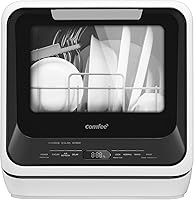
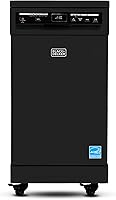
This comparison sets the COMFEE' 1.32 gal countertop model against the BLACK+DECKER 18-inch portable. Neither needs a permanent install, so both can move with you.
For the full range of types, see our countertop and portable dishwashers guide.
 Best for a small counter with a built-in tank
COMFEE' 1.32 Gal Countertop Dishwasher
 Best for eight place settings on wheels
BLACK+DECKER 18-Inch Portable Dishwasher
How the two types differ at a glance
The countertop model is smaller and lighter and can run from a tank, while the portable holds eight place settings and needs a faucet. Both need power nearby and a drain for the waste water.
| Product | Best for | Size | Weight | Hookup | Our score |
|---|---|---|---|---|---|
| COMFEE' 1.32 Gal Countertop Dishwasher | a small counter with a built-in tank | 16.5 x 17.1 x 17.2 in | 36.6 lb | 1.32 gal tank or faucet adapter | 8.5 |
| BLACK+DECKER 18-Inch Portable Dishwasher | eight place settings on wheels | 17.6 x 23.6 x 35.6 in | 116 lb | Quick connect to faucet, 59 in hose | 8.1 |
Compare the two on floor space first, then hookup, then capacity. Those three decide most of the fit in a small kitchen.
Our score weighs specs, features and buyer feedback against what you're shopping for. The COMFEE' scores a little higher here because it fits where the portable can't, but the portable wins on load size.
Countertop vs portable dishwasher: size, height and floor space
The countertop unit sits on the counter and stands 17.2 in tall, while the portable stands 35.6 in tall and needs floor room beside the counter. That height difference changes where each one can go.
The COMFEE' measures 16.5 in wide, 17.1 in deep and 17.2 in tall. COMFEE' asks for more than 19.6 in between the counter and the upper cabinet, so check that gap before you buy.
The BLACK+DECKER takes up about 17.6 by 23.6 in of floor and stands 35.6 in tall. BLACK+DECKER says it can sit alongside your kitchen counters and adds countertop space of its own.
The portable also weighs 116 lb, so the route matters as much as the spot. A narrow door or a tight turn can stop a unit that would fit where it is going.
If you want a countertop model with a tank, see best countertop dishwashers with a water tank for more choices.
Water hookup: a tank for the countertop, a faucet for the portable
The COMFEE' runs from its 1.32 gal tank or a faucet adapter, while the BLACK+DECKER uses a quick connect to the faucet. Both need power and a place for the waste water to drain.
A tank model means you fill the water by hand before each run. That adds a step, but it works when the faucet is far away or doesn't take an adapter.
The tank holds about 5 L, so a busy day means several fills. A faucet hookup removes that step, and the tank saves a faucet connection, not a drain.
Check your faucet first
A faucet model depends on your faucet. Check the aerator type and whether it is a pull-down or spray model, and follow the maker's manual for the adapter.
The BLACK+DECKER's hose is 59 in long, so the sink has to sit within that reach. Measure from the faucet to the spot, and leave room for the hose to lie without a sharp bend.
Plan the spot so the drain can reach a sink, and keep the power cord clear of the hoses. Ask a licensed plumber about anything that changes your pipes.
Capacity and place settings
The BLACK+DECKER holds eight place settings, and the COMFEE' is rated for 30 or more items with plates up to 9.5 in. Those figures measure different things, so compare them with the dishes you actually wash.
A place setting covers one person's plate, bowl, glass and utensils. An item count is a looser total, since one pot or one platter counts as a single item.
To compare fairly, count the dishes you wash on a typical day, then check that count against each unit's rating. If you cook small meals, the COMFEE' load may be enough.
If you cook for a family or host often, the eight settings on the BLACK+DECKER leave more room in each load. BLACK+DECKER says the portable also takes serving platters, and its upper rack adjusts for taller dishes.
The COMFEE' stops at 9.5 in plates, so measure your dinner plates first. For a countertop model from the same brand as the portable, the BCD6W holds six place settings and has its own BCD6W review.
Programs, drying and noise
The COMFEE' has Normal, Rapid, Fruit and Glass programs plus an Air Refresh mode, and the BLACK+DECKER has six cycles, including a 90-minute cycle. Both give you a few choices, so size and hookup should carry more weight than programs.
The COMFEE' includes an Air Refresh mode that circulates air to help dishes dry. You can turn it off if you don't need it.
The COMFEE' is rated at 62 dB, so plan for some noise if the kitchen shares a room with a bed. BLACK+DECKER gives no noise rating for this portable, so ask the maker if sound matters to you.
Water and energy claims for each type
The COMFEE' says its unit uses about one third of the water that handwashing does, but it gives no gallons-per-load figure. That is the brand's claim, so treat it as a comparison rather than a measured number.
The BLACK+DECKER is Energy Star certified, which covers energy use. You can read what the label measures at Energy Star.
BLACK+DECKER gives no water figure for this portable. When you compare, use the same kind of number, since a cycle, a load and a tank fill can measure different things.
Daily use: controls, racks and extras
The BLACK+DECKER uses push buttons and has an LED display. The COMFEE' uses a touch panel and comes with a fruit basket and a water pitcher.
The BLACK+DECKER's upper rack adjusts for taller dishes, which matters when you load pots and platters. The COMFEE' has 360 degree dual spray arms and leakage protection.
Moving, storage and setup
The COMFEE' weighs 36.6 lb, while the BLACK+DECKER weighs 116 lb and rolls on wheels. Wheels help on a flat floor, but a 116 lb unit still needs a clear path and a second person on steps or thresholds.
Storage works differently too. A countertop model needs counter space while it runs, then a shelf or cupboard when idle.
A portable needs floor room, or a spot where it can be pushed aside. Before you move either unit, follow the manual for emptying the tank and disconnecting the hoses.
Which type fits common small-kitchen layouts
Match the type to your layout before you compare features, because the layout often decides the answer on its own.
A galley kitchen with little floor
In a narrow galley kitchen, the COMFEE' on the counter makes sense if the counter has room and 19.6 in of clearance above it. A portable that stands 35.6 in tall and covers 17.6 by 23.6 in of floor can block the walkway while it runs.
A studio or open kitchen with free floor
If you have an open wall or a gap beside the counter, the BLACK+DECKER can park there and roll to the sink on dish day. The sink still has to sit within the 59 in hose, and the drain hose needs a path to a sink.
A kitchen where the sink is far from the spot
When the faucet is far from where the unit will sit, or your faucet won't take an adapter, the COMFEE' tank is the workable choice. You fill it by hand, and the waste water still needs a place to go.
Who a countertop model suits
A countertop model suits a small kitchen where floor space is the main limit. It works best with a counter that has room for the unit and at least 19.6 in of clearance above it.
- A small kitchen where floor space is the limit
- A counter with 19.6 in of clearance above it
- A renter who wants no permanent install
- A household that runs small loads
Skip it if you cook for a crowd or your cabinets sit low. A big load may take more than one run, and a short gap above the counter can rule the unit out.
If you are still asking whether a countertop model earns its space, read are countertop dishwashers worth it. It covers who gains the most from a small unit and who should skip one.
Who a portable suits
A portable suits a kitchen with floor room and a faucet close by. It also suits anyone who wants eight place settings and can move the unit out of the way when it is not in use.
- A kitchen with floor room beside the counter
- A faucet within reach of the 59 in hose
- A household that wants a full load of dishes in one run
- Someone who can move a 116 lb unit with help
Skip it if you have no floor room or no faucet within reach of the hose. A rolling unit can be pushed aside when you need the floor, which helps in a small kitchen, and best portable dishwashers on wheels lists more rolling choices.
If you are torn between a portable and a permanent install, portable dishwasher vs built-in covers that choice.
Common mistakes when choosing between the two
Four mistakes are easy to make here, and each one is simple to check before you buy.
- Comparing items to place settings. The COMFEE' is rated by items and the BLACK+DECKER by place settings, so the two numbers don't line up.
- Skipping the clearance. A countertop unit needs 19.6 in between the counter and the upper cabinet, and a short gap can rule it out.
- Ignoring the hose reach. A portable with a 59 in hose needs a faucet within that reach, so measure the distance first.
- Forgetting the weight. A 116 lb portable has to pass through the door and every turn, so a unit that fits the floor may still fail the route.
Setup checklist before you buy either type
Check the counter or floor space, the faucet, the outlet, the drain, the door and your lift plan before you buy. Each one can rule out a model that looks right on paper.
- Floor width and depth for a portable, or counter width for a countertop
- Clearance between the counter and the upper cabinet, at 19.6 in for the COMFEE'
- Faucet type and aerator, if you plan to use an adapter
- An outlet within reach of the power cord
- A drain spot the hoses can reach without a sharp bend
- The route through the door and any turns
- A lift plan for 36.6 lb or 116 lb
If you rent, get any landlord approval in writing and keep it with your lease. That protects you if a question comes up later.
Countertop or portable dishwasher: which fits your kitchen
Pick the countertop if floor space is tight, and pick the portable if you have floor room and a faucet close by. Those two facts decide most of the choice before you compare features.
- Pick the COMFEE' 1.32 gal countertop if you have little floor space and can fill a tank by hand.
- Pick a countertop if you need a unit that can run from its tank without a faucet.
- Pick the BLACK+DECKER portable if you have floor room, a faucet within 59 in and want eight place settings.
- Pick a portable if you want to push the unit aside when you need the floor.
Countertop dishwasher or portable dishwasher for a tight kitchen
Measure the counter and the floor, check your faucet, and then choose. For a renter's checklist, the apartment guide covers the decisions that matter most before you buy.
Frequently asked questions
Is a countertop dishwasher better than a portable one?
Neither is better for every kitchen. A countertop model suits a small space with little floor room, while a portable suits a kitchen with a faucet nearby and floor space for a rolling unit, so measure the floor and counter first.
Does a countertop dishwasher need a faucet?
No, the COMFEE' 1.32 gal model runs from its built-in tank, which you fill by hand, and it can also connect to a faucet with the included adapter. Either way, it needs power nearby and a drain for the waste water.
How much floor space does a portable dishwasher need?
The BLACK+DECKER portable takes up about 17.6 by 23.6 inches of floor and stands 35.6 inches tall. Add room for the door to open and for the 59 inch hose to reach your faucet, and plan the route in, since the unit weighs 116 pounds.
Which holds more dishes, a countertop or a portable?
The BLACK+DECKER portable holds eight place settings, while the COMFEE' countertop is rated for 30 or more items with plates up to 9.5 inches. The two ratings measure different things, so compare each one with the dishes you wash most often.