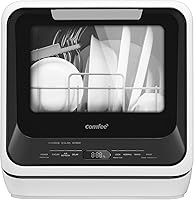
Countertop Dishwasher With No Plumbing: How It Works
A countertop dishwasher with no plumbing uses a water tank that you fill by hand, so it does not connect to a water line. It still needs an electrical outlet and a place for the waste water to drain.
On this page (9 sections)
- How a countertop dishwasher with no plumbing works
- What no plumbing means and what it does not
- The five tank models in this guide
- Where a no-plumbing model fits best
- Power, drain and clearance before you buy
- Tank models versus a faucet connection
- Water use and energy for a tank model
- Who should skip a no-plumbing countertop dishwasher
- Choose a countertop dishwasher with no plumbing
A countertop dishwasher with no plumbing skips the water line, so you fill a tank by hand instead. That is the main feature, and it matters for renters, dorm residents and RV owners who cannot add a water line.
It is not magic, though. The unit still needs power, you still fill the tank yourself, and the waste water still needs a place to go.
This guide explains how the setup works step by step, what the no-plumbing label does and does not mean, and which tank models we looked at. For the full map of countertop and portable types, see the countertop and portable dishwashers guide.
How a countertop dishwasher with no plumbing works
You fill the tank, plug the unit in, pick a program, let the cycle run, and then empty the waste water as the manual says. The steps are simple, and they follow the same order for each tank model in this guide.
Fill the tank by hand
Each tank model in this guide holds about 5 liters, or 1.32 gallons. Fill it to the water level the manual shows, using the pitcher, cup or funnel your model includes.
EUHOMY and NOVETE both describe a water-level indicator, which tells you when the tank has enough water. Check that light or display before you start a cycle.
Run a countertop dishwasher with no plumbing
Plug the unit into an outlet and choose a program that fits the dishes. Load the plates so the spray arms can reach them, and scrape off heavy grease or burnt-on residue first, as EUHOMY advises.
Empty the waste water
Empty the waste water when the cycle ends, and follow the maker's manual for the drain. The HAVA, EUHOMY and NOVETE tank models list a drain hose in the box, so check your manual for where that hose should go.
EUHOMY also describes a forced-drainage step (long-press Dry and Power). Find it in the manual before you need it.
What no plumbing means and what it does not
No plumbing means no water line and no permanent install. It does not mean no setup at all, because the unit still needs power and a drain route.
It still needs power
Every tank model here plugs into an outlet, so plan the outlet before the unit arrives. The HAVA tank model has a 55-inch power cable, which is a useful number to measure your outlet against.
It still needs a drain
Waste water has to go somewhere, so plan the drain route before you buy. Keep the hose free of kinks, and follow the manual for where the hose should end.
The five tank models in this guide
Five tank models in this guide share the no-plumbing setup. They differ mainly in size, capacity and the programs they offer, so compare those numbers before you choose.
| Model | Tank | Capacity | Size, W x D x H (in) |
|---|---|---|---|
| COMFEE' 1.32-gallon | 1.32 gallons (5 L) | 30+ items, plates up to 9.5 in | 16.53 x 17.13 x 17.24 |
| HAVA 5-liter | 5 L | Up to 4 full place settings, 30+ pieces | 16.7 x 16.8 x 18 |
| Hermitlux 5-liter | 5 L | 5 place settings | 16.85 x 16.73 x 18.23 |
| EUHOMY 5-liter | 5 L | 30+ items, plates up to 10.25 in | 16.73 x 16.85 x 18.03 |
| NOVETE 5-liter | 5 L | 4 place settings, 12-inch dishes at an angle | 16.9 x 16.8 x 18.1 |
The table uses the sizes the makers give. A few makers give slightly different figures in different places, so measure your own space before you buy.
COMFEE' 1.32-gallon tank model
COMFEE' says the unit has six programs and takes plates up to 9.5 inches. The water tank can also connect to a faucet with the included hose.
The unit weighs 36.6 pounds, and COMFEE' says it needs more than 19.6 inches of clearance between the countertop and the wall cupboard.
HAVA 5-liter tank model
HAVA says the tank model needs no installation and uses 5 liters per wash cycle. It weighs 13 kg, which is about 28.7 pounds, and its drying function runs about 60 minutes of hot air after a cycle, according to HAVA.
Hermitlux 5-liter tank model
Hermitlux says its model offers a delay of up to 18 hours, and it describes 60 minutes of hot-air drying after a cycle. The unit weighs 30.9 pounds, and Hermitlux says there should be at least 20.08 inches between the countertop and the wall cabinets.
EUHOMY 5-liter tank model
EUHOMY says the unit runs at 40 dB, and it weighs 28.6 pounds. EUHOMY advises more than 19 inches of vertical clearance between the countertop and the upper cabinets.
NOVETE 5-liter tank model
NOVETE says its model holds four full place settings and fits dishes up to 12 inches loaded at an angle. It weighs 28 pounds and comes with a 61-inch inlet hose.
NOVETE also suggests a 5-minute run before first use, to clear dust and odor from shipping.
Where a no-plumbing model fits best
These models suit renters, dorms, RVs and small kitchens where a water line is hard to add. They suit large households that run full loads every day less well.
Renters and dorms
Nothing needs to be installed, and you can take the unit with you when you move. Ask your landlord before you add any faucet connection, even though a tank model does not need one.
RVs and tiny houses
A tank model suits a small kitchen where the sink and outlet are close, but the water has to be carried in. Plan where the refill comes from and where the drain goes before the unit arrives.
Households that run full loads
A 5-liter tank sets how much water each fill holds, so a big household that runs full loads every day may refill often. A faucet-fed model or a rolling portable with more place settings may suit those homes better.
Whether a countertop model is worth the trade-off depends on how often you wash, so Are Countertop Dishwashers Worth It? An Honest Look weighs the pros and cons.
Power, drain and clearance before you buy
Check the outlet, the drain route and the clearance under the cabinet first, since a tank model needs all three. Each one is a simple measurement, and each one can rule out a model.
Clearance under the cabinet
The makers give different clearance advice. COMFEE' says more than 19.6 inches, EUHOMY says more than 19 inches, and Hermitlux says at least 20.08 inches.
Measure your cabinet gap, and compare it with the tallest tank model in the table, which is 18.23 inches.
Cord and hose reach
The HAVA power cable is 55 inches, and its inlet hose is 61 inches. Measure from the outlet and the sink to the spot where the unit will sit, and leave some slack in the hose.
For every model's size in one table, see small dishwasher dimensions.
Tank models versus a faucet connection
Tank models trade the faucet check for the filling job. A faucet connection saves the filling, but it depends on your faucet and needs the hoses set up correctly.
All five tank models in this guide also offer a faucet mode, so the choice is not all or nothing. Check your faucet first if you consider a connection, and compare the two setups in Water Tank vs Faucet Hookup Countertop Dishwashers.
EUHOMY says its tank model fits G3/4-inch faucet connections and asks buyers to buy a faucet adapter separately. COMFEE' says an adapter comes with its tank model.
Water use and energy for a tank model
HAVA and Hermitlux both say their tank models use about 5 liters per cycle. That is the makers' claim, so check it against the manual and your own habits.
Claims against hand washing vary by maker. HAVA says a quarter of the water, COMFEE' says one third, and Hermitlux claims savings of up to 83 percent.
For RV use, How Much Water Does an RV Dishwasher Use? covers water use in a rig. To see how the water use compares with hand washing, read Dishwasher vs Hand Washing: Which Uses Less Water?.
If you want an efficiency check, Energy Star lets you search certified models at energystar.gov. Use that as one input, not the only one.
Who should skip a no-plumbing countertop dishwasher
A no-plumbing model is a poor match for a large household that washes big loads every day. The tank will need frequent refills, which adds steps to every load.
A kitchen with no outlet near the counter will also struggle, since every model here needs power. Find an outlet and a drain route first, then choose the model.
Choose a countertop dishwasher with no plumbing
Pick a tank model if you have an outlet, a drain route and no faucet hookup. Pick a faucet-fed model if your faucet takes an adapter and you want to skip the filling.
Pick a larger model if your household runs full loads most days. Measure the outlet, the drain route and the cabinet gap before you order, and then compare the tanks in Best Countertop Dishwashers With a Water Tank.
Frequently asked questions
How does a countertop dishwasher with no plumbing work?
You fill the water tank by hand, plug the unit in, choose a program and run the cycle, then empty the waste water as the manual says. The tank models in this guide hold about 5 liters, or 1.32 gallons, so plan refills for full loads.
Does a countertop dishwasher with no plumbing need electricity?
Yes, the no-plumbing label covers the water line only, and the unit still plugs into an outlet. Check the outlet's location and the power cord length before you buy, since a cord that does not reach can rule out a spot, and follow the manual for power and drain setup.
How much water does a tank model use per cycle?
HAVA and Hermitlux both say their tank models use about 5 liters per cycle, which is the makers' claim. Check the manual and compare that figure with how much you wash, and plan for a refill between loads before you buy.
Can a no-plumbing dishwasher connect to a faucet later?
Yes, all five tank models in this guide offer a faucet mode through an inlet hose, if your faucet takes an adapter. Check your faucet first and follow the manual for the hose setup, since a tank model works fine without that connection.